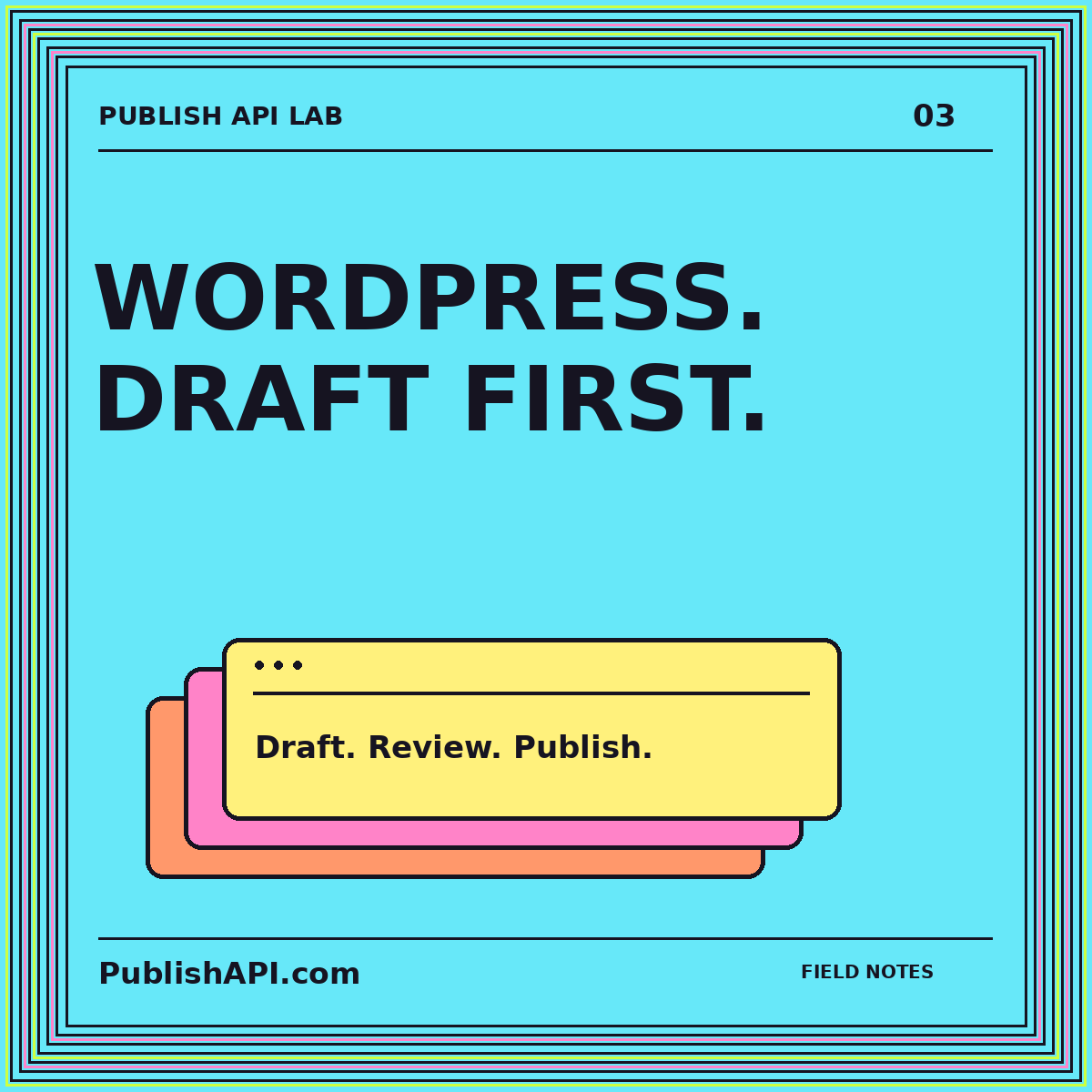
A WordPress publishing integration is easier to operate when its first successful outcome is a reviewable draft, not a live post. That choice creates room to inspect formatting, taxonomy, images, and the publication’s actual theme before the content becomes public. It also forces the integration to distinguish between creating a record and approving a release, which is useful long after the initial implementation.
This guide lays out a draft-first implementation plan for a site you are authorized to manage. It does not supply credentials or a PublishAPI.com connector. The focus is on the decisions around an integration: field mapping, record identity, review, failure recovery, and public verification. Verify authentication details against the documentation for your actual WordPress environment rather than assuming all hosting arrangements work identically.
Start with a representative content sample
Choose an article that exercises the publication’s normal structure. Include a title, excerpt, headings, a list, an internal link, an external source, and an image with meaningful descriptive text. Avoid using a one-sentence test post as the only proof that the integration works. Such a post cannot reveal whether the destination handles the content you actually intend to publish.
Write down how the source represents each part. Is the body HTML, Markdown, or an editor-specific structure? Are categories stored as labels or destination identifiers? Is the image already in the site’s media library? These questions should be answered by an explicit mapping rather than by scattered transformations inside the request code.
Keep the sample as a regression fixture. When the adapter changes, use it again to compare the resulting draft. A stable fixture makes it easier to distinguish a content problem from a change in your own integration behavior.
Understand the destination record
The official WordPress REST API posts reference documents creation through POST /wp/v2/posts and update operations for an existing post identifier. It includes fields such as title, content, excerpt, categories, tags, featured media, and status. Documented status values include draft, pending, publish, future, and private. Use the reference to confirm the exact field definitions your client relies on.
For the first implementation, map a narrow set of fields and request a draft. Keep your own editorial state separate from the destination status: an internal record can be awaiting review even after a destination draft exists. The remote draft is a preview artifact, not proof that your organization has approved the content.
The WordPress Publish API topic provides the broader workflow context. This article concentrates on keeping the remote record understandable and recoverable as the source changes.
Keep identity stable across edits
When creation succeeds, save the returned destination identifier with the source record and site context. Do not use the article title as the only way to find the remote post again. Two drafts can share a title, and an editor may change a headline without intending to create a different story.
On a later edit, decide whether the operation should update the existing remote draft or create a distinct publication. Make that choice explicit in your application. A common integration mistake is to run the create path every time a source file is saved, producing several nearly identical drafts that someone must reconcile manually.
Preserve the source revision sent with each operation. The operator should be able to answer which version produced the current destination draft. Without that information, a successful update can still be confusing when a reviewer is looking at a newer local version.
Treat media and taxonomy as dependencies
An article body and its supporting assets belong to the same editorial package, but they may have different preparation steps. Decide how your project handles images that are already available at the destination and images that need a separate approved import process. Do not assume that a source filesystem path will be meaningful to a remote website.
Review taxonomy mapping with an editor. A source label might correspond to a destination category, a tag, or nothing at all. Automatically creating a new label whenever spelling differs can clutter the publication and make archive navigation less useful. Keep a controlled mapping where the editorial organization matters.
Preview the post within the theme, not only in a response object. Look at image placement, captions, heading sizes, lists, code blocks, and links. The objective is a publication that reads correctly, not merely a request that produces a successful response.
Make approval a distinct operation
Provide a visible review stage after the remote draft is created. The reviewer should see the exact content revision and the intended destination. Keep the final release action separate from routine synchronization so that fixing a typo in a draft does not accidentally become an instruction to publish it.
A proposed review checklist can cover factual claims, attribution, image descriptions, excerpt accuracy, and the canonical address. Tailor it to the publication rather than making every post pass through an enormous generic form. The useful checklist catches the mistakes your team is actually capable of making.
If the reviewer edits content directly in WordPress, decide how those changes relate to the source system. Either bring the edits back into the owned record or clearly identify the destination as the authority for that stage. Two independently editable copies with no reconciliation rule create a conflict waiting to happen.
Handle failures without multiplying posts
Distinguish a rejected request from an uncertain result. If validation clearly rejects the content, return the error to the editor or adapter owner. If the connection fails after the request may have reached the destination, first determine whether a remote record was created. A blind create retry can produce a duplicate.
Keep logs useful but restrained. Record the site context, source identifier, revision, operation, and relevant response status. Do not copy authentication secrets or the entire private draft into routine logs simply because doing so is convenient during development. The publishing credentials guide examines that boundary in more detail.
Practice recovery with a staging draft. Interrupt the client, restart it, and confirm that it can identify the existing destination record. The recovery procedure should be an ordinary part of the tool rather than an undocumented script known only to its original developer.
Verify the publication as a reader
After an approved release, inspect the public page. Check the title, body, excerpt where it appears, image, category placement, and relevant links. Open the page without relying on an administrator session, because an editor’s preview can obscure differences between private and public states.
Record the destination result in the source workflow. If publication is confirmed, retain the public URL and the source revision associated with that confirmation. If only the request was accepted, say so. A truthful state description is more useful than a reassuring message that cannot be supported by the checks performed.
Keep a correction path ready. An existing post may need a content update, a revised image description, or a change to its public status. Test the appropriate operation in staging and document who may authorize it before the first urgent correction arrives.
Rehearse a correction on the same remote draft
Use an authorized non-production site and a representative source article. Create one draft, record its destination identifier, and ask an editor to inspect its title, excerpt, and image. Then change only the excerpt in the source and approve that revision for another preview.
Send the correction through the update path for the recorded post, not through a fresh create operation. Inspect the destination again: there should be one intended draft, with the revised excerpt and the unchanged parts of the article preserved. Keep the source revision and destination identifier together in the test notes.
Finally, simulate an interrupted response in your own test harness. The operator should reconcile the known draft before trying another creation. That small rehearsal exposes identity mistakes without making a public post or relying on a successful request as the sole proof of correctness.
Conclusion: make drafts the integration contract
A draft-first approach gives the team a shared artifact to inspect before making a public commitment. Start with a representative sample, map a small set of fields, store the destination identifier, and separate synchronization from approval. Then test uncertain delivery and correction, not just the happy path. The result is a publishing integration that editors can understand and operators can recover, rather than a script whose success is defined by the absence of an immediate error.